Why Did You Give Away Your Island? This is part of a five-part essay about a question that sounds like it belongs to a card game but isn't really about cards at all: why would you give something away? It's told through Magic: The Gathering, a game I play in a way most people find strange — not to beat my opponents, but to give to them. You don't need to know the game to follow along. It's really about generosity, power, and what happens when you build a room where everyone gets to play.
So I learned to play
But I learned to see much earlier.
Because every community has its rituals, and the Commander pod has more than most. Before I understood the stack, before I could parse a board state or hold priority, I was already reading the room. Watching the way people set up their playmats, carefully, deliberately, laying out their favourite stage. Watching the way they shuffle. Some with a flourish, some with a quiet, mechanical efficiency that scrapes against the card sleeves. A sound I remember from the regional qualifiers, the sound of someone trying to keep their hands from shaking.
I noticed the gap between what people said and what they showed. The way they'd introduce their decks "It's just a casual list," or "It's nothing crazy," or the telltale "It's basically a precon." It is never basically a precon. That was the first mask I learned to recognise; the performative humility of the deck-builder, a persona shaped with hooks and sharp corners, designed to ensure you only truly know the deck's wrath once it has already dismantled you. I watched them announce the stack, curl over their hands when the threat arrived, arrange their tokens like talismans. For there’s a card for every creature, like a desperate encyclopedia of experience for show. Here I am. I've got tokens for everything. I know the game, and I will make sure you know that.
And I remember thinking and leaning back against my chair. I don't think I want to do that.
The Masks They Wear
It wasn't a judgement against the players I'd met. Rather, it like a moment of recognition, or a side of me seeping its way and evolving into this new, exciting shape bounded by the Commander format. Something in me was already sorting. Not better from worse, but mine from not mine. The bluster, the misdirection, the careful choreography of looking weak while building toward something devastating — I understood why people did it. I just knew, even then, that it wasn't the kind of player I wanted to be.
What I wanted, I think, was to sit at a table and have everyone see me. To play with my hand open, metaphorically and maybe literally. To build something that worked not because it surprised people, but because it included them. I didn't have the language for that yet. But the cards were already slowly taking me there.
A Gentle Hand and the Chokehold
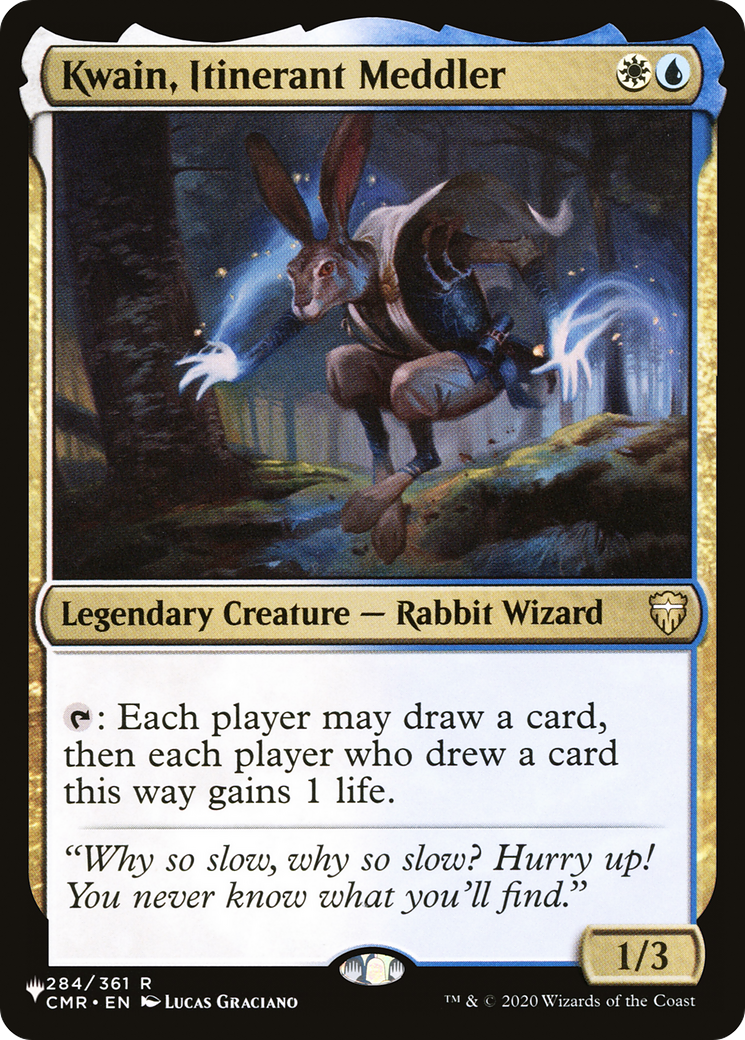
I remember the first card that made me feel something I couldn't explain. It wasn't powerful. It wasn't expensive. It was Kwain, Itinerant Meddler — a small, unassuming rabbit monk whose ability reads: Each player may draw a card. Each player who drew a card this way gains 1 life.
That's it. That's the whole card. Symmetrical. Generous. Entirely transparent. You give everyone a card, you give everyone life, and you move on. There's no trick. There's no hidden angle. There's just the act of offering, and whatever the table decides to do with it.
I remember holding that card and feeling something click — not in my deck, but in me. This was the kind of Magic I wanted to play. Not the kind that says "destroy target creature" or "exile all permanents your opponents control." The kind that says each player may draw a card. The kind that makes everyone's game a little better, a little fuller, a little more alive.
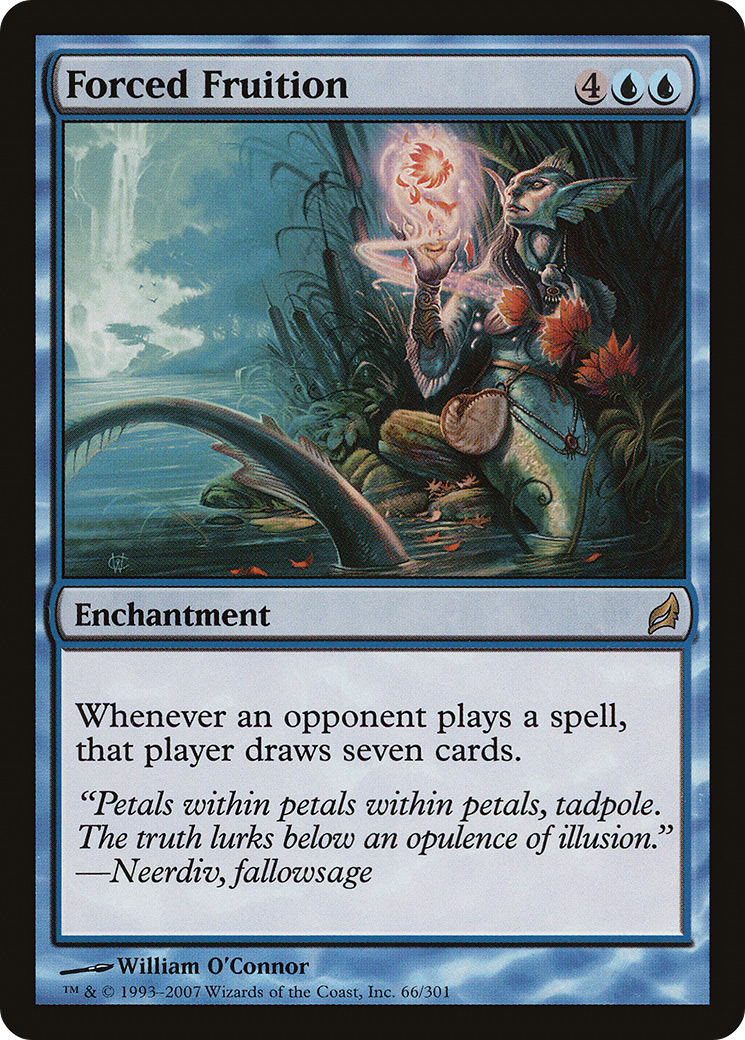
Around the same time, I found Forced Fruition. If Kwain was the gentle hand, Forced Fruition was a chokehold. Whenever an opponent casts a spell, they draw seven cards. Seven. On the surface, it looks like a gift. You're giving them more resources than they could possibly need. But the truth — the beautiful, terrible truth — is that seven cards per spell will drown you. Your library becomes a countdown. Your own abundance becomes the weapon. Here, greed was able to manifest itself into a card, into a shape I could hold onto.
I loved it. I loved that it was a gift that could destroy you. That generosity, taken far enough, becomes its own kind of pressure. Forced Fruition taught me something that Kwain alone couldn't: that giving is never neutral. Every gift changes the shape of the table. Every draw changes what's possible. The question isn't whether to give — it's how much, and what happens next. And what happens next isn't mine to decide. Because once the card leaves my hand, it becomes whatever the table can hold. Help, burden, confusion, or in some cases, nothing at all.
Those two cards became the bookends of my philosophy. Kwain on one side, whispering: share, and see what happens. Forced Fruition on the other, grinning: share, and watch them drown in it. Over the months, I built myself around this.
The Architecture of Giving
Enchantments became my medium. There's something about the permanence of them, the way they sit on the table and stay, altering the rules of the game without requiring constant attention. They become architecture, pillars that build a foundation. They change the environment rather than the moment. A creature attacks and is gone. A sorcery resolves and fades. But an enchantment lingers. It becomes part of the landscape. The table adjusts around it the way a river adjusts around a stone — slowly, inevitably, without anyone deciding to. Well, at least until it gets removed.
I loved that. I loved the idea of building a world for other people to play in, rather than building a weapon to point at them. Is that not its own kind of hunger — the appetite not to destroy but to shape?
Group hug became my philosophy. Not the naive kind — not "let's all draw cards and hold hands" — but the deliberate, systems-driven kind. The kind where giving resources is a form of regulation. Where making someone's deck work better is a way of saying: I want to see what your deck can do. Where generosity isn't weakness but strategy, and the win condition isn't reducing life totals but curating an experience.
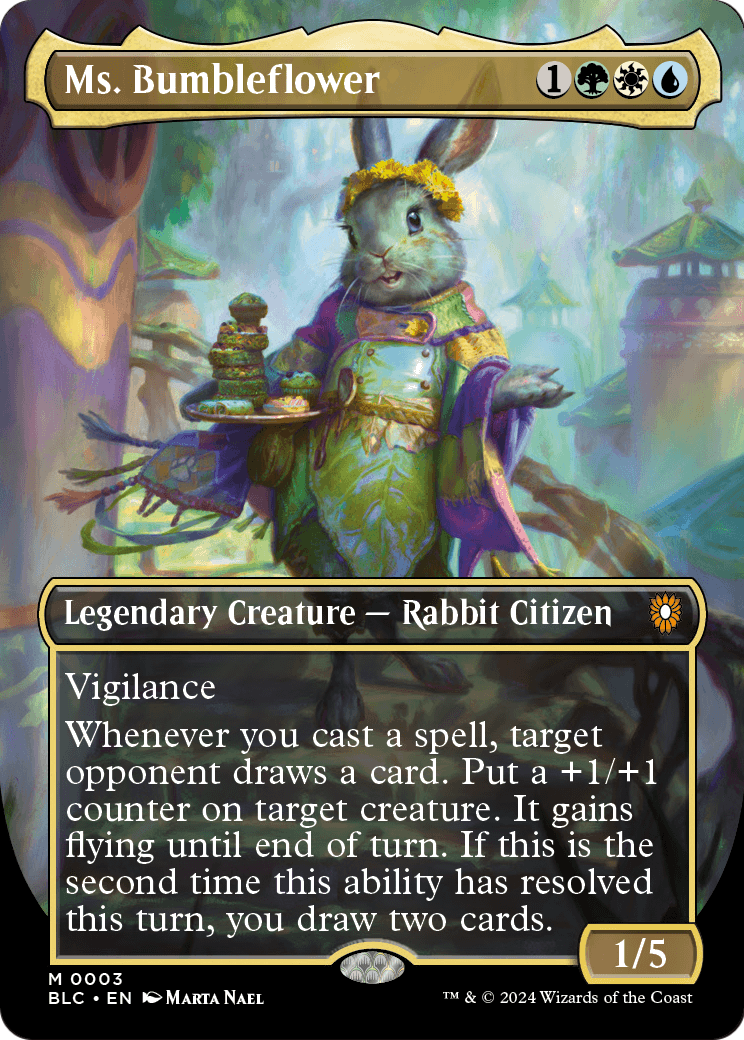
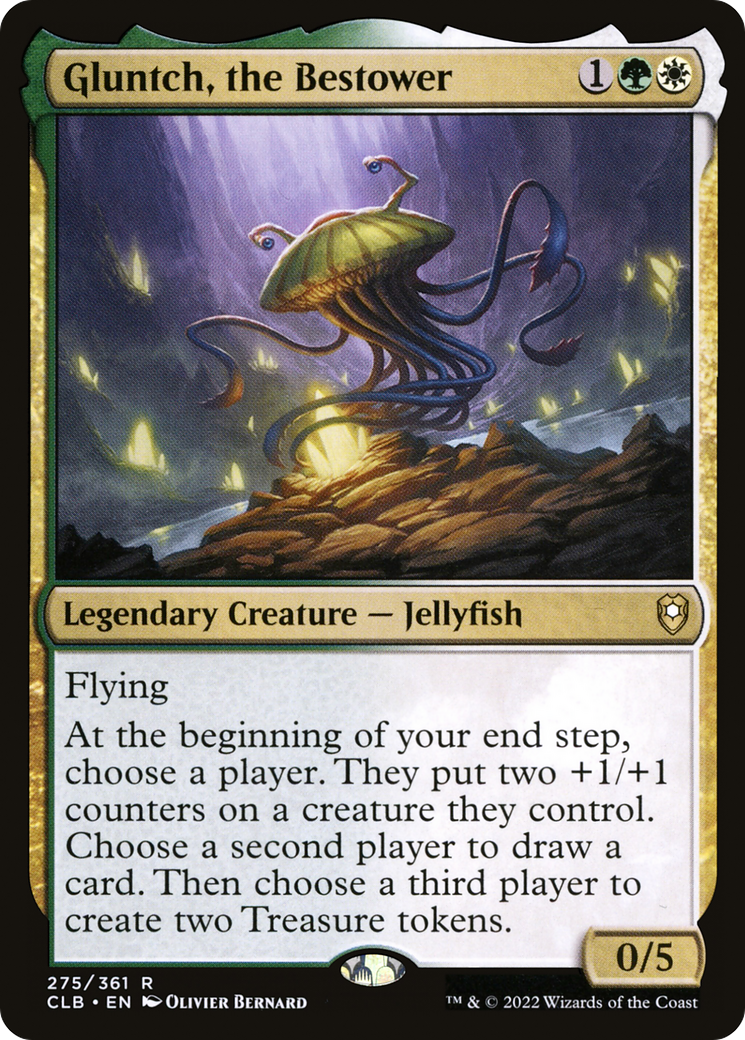
I built Kynaios and Tiro, the couple who ramp the entire table, giving everyone lands and cards, and then punish the greed with Manabarbs and Karma. I built Gor Muldrak — the Salamander deck, the one that hands everyone 4/3 tokens while protecting me from them. I built Zedruu — the gift-giver, who donates permanents and draws cards for the trouble. I built Ms. Bumbleflower — the counter distributor, who decides who gets to grow and who doesn't. Each deck a different answer to the same question. Each one saying: here, take this. Now let's see what you do with it.
And in building these decks, I discovered something about myself that I should have known all along. I'm a systems thinker. I like interlocking engines — enchantments that feed other enchantments, triggers that cascade into other triggers, board states where every piece has a purpose and every purpose connects to the next. I don't run tutors. I don't run pre-packaged combo lines. I run density — enough synergistic pieces that the system finds its own paths, in real time, depending on what the table needs. The deck breathes. The deck decides, almost, as though the architecture itself has learned to want something.
Yellow Is The Colour Of Choosing Differently
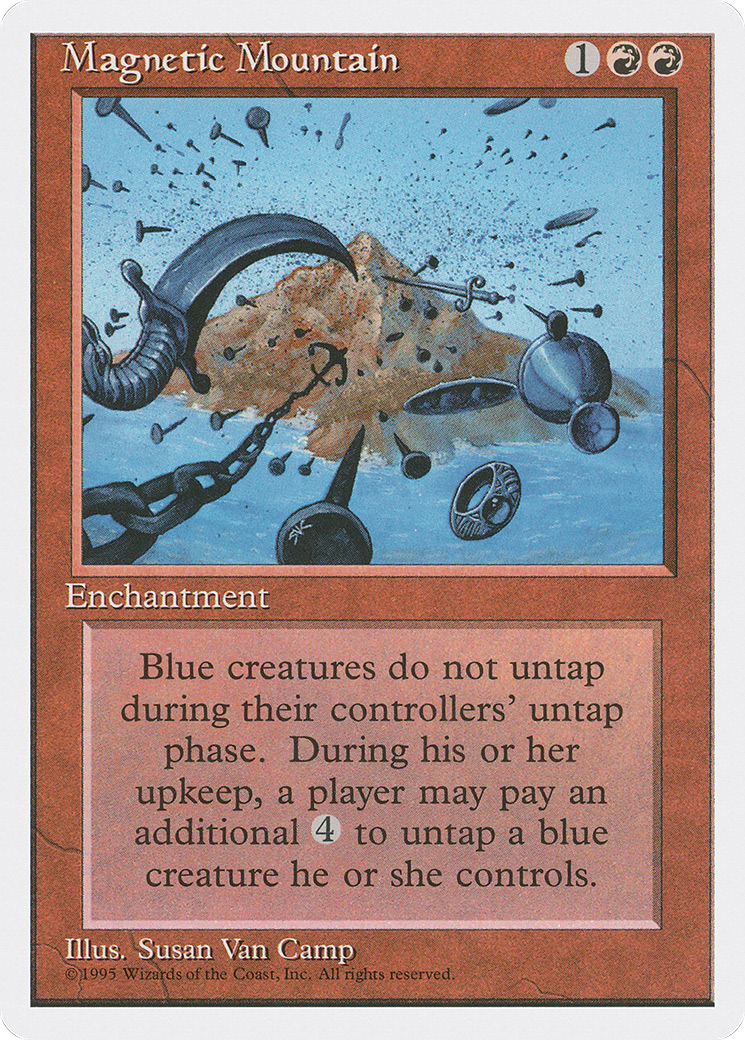
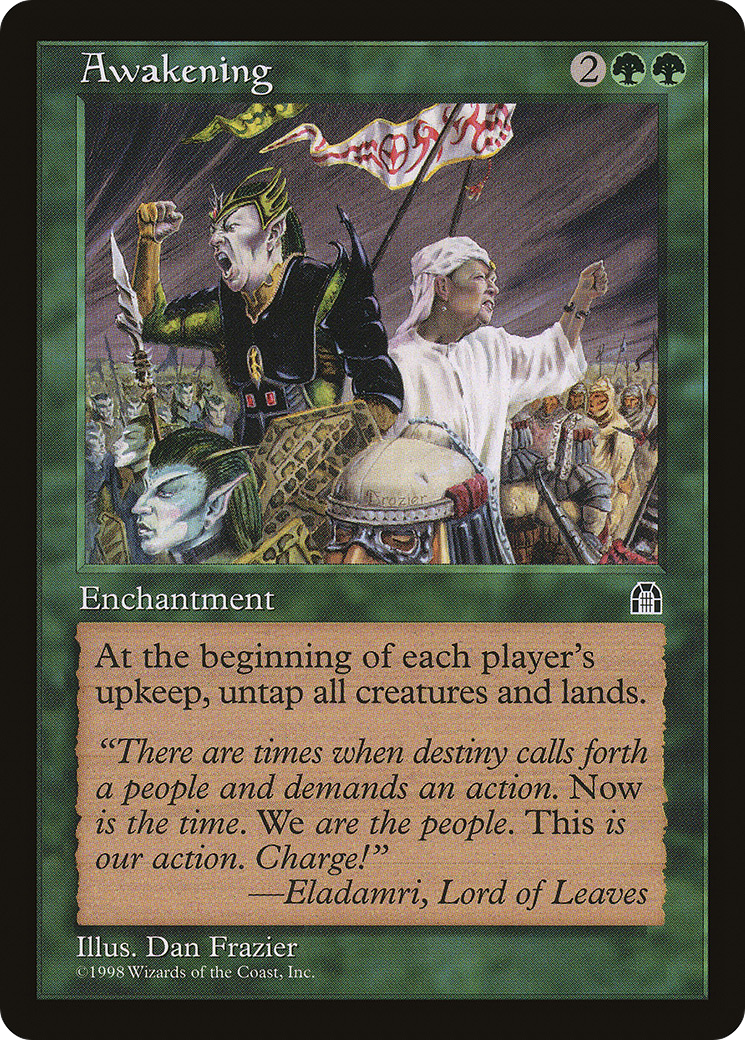
I also started collecting with intention. I gravitated toward cards with nothing to do with market value, which I'd come to understand as a narrow, borrowed kind of worth. I was choosing for texture — for the way a card felt when it sat on the table. Cards from Exodus and Tempest and Prophecy. Cards with text boxes so long and strange that people have to read them twice. Cards like Magnetic Mountain, from 1994, which prevents blue creatures from untapping — a piece of vintage stax jank that makes blue players go quiet with disbelief when it hits the table. Cards like Thelon's Curse, Lifetap, Reality Twist — enchantments that warp the rules of engagement so subtly that the table doesn't realise what's happening until it's too late. By then the architecture has already settled. By then the room has already changed.
These are my cards. These are the ones I keep. The seven-dollar staples? The meta-relevant chase cards? They're noise. They don't belong in the world I'm building.
I think about yellow. That bright, defiant colour the community dismissed — too loud, too different, too far from the gothic dark they wanted. Here yellow is the colour of choosing differently. Of walking into a room full of meta-relevant staples and seven-dollar chase cards and saying: these are not the cards that speak to me. My collection doesn't look like anyone else's at the table. That's the point. That's the whole point.
What Kind of Player Was I Becoming?
I wanted to play in a way that was visible. Transparent. A way where giving wasn't a disguise for taking, but the actual strategy. Where the cards on my table told you exactly what I was doing, and the question was never what is she hiding but what is she building?
Kwain sits in my deck and offers everyone a card. Forced Fruition sits in my deck and offers everyone too many cards. And between those two poles — the gentle hand and the chokehold — I was constructing a philosophy out of cardboard and ink. A way of playing that says: I'm not here to win against you. I'm here to see what happens when we all have more. So much more.
What kind of player was I becoming? The one who gives. But never naively — not without teeth. I'll be the one who gives strategically, who understands that generosity reshapes the board as surely as any board wipe, who knows that the most powerful thing you can do at a table isn't to destroy someone's plan but to change the conditions under which everyone gets to play. Not to punish the ones who think group hug is a joke, who hear "each player draws a card" and think she doesn't know what she's doing — but to make the system visible enough that they can respond to it. They've been part of it since the moment they sat down. The question is whether they get to answer back.
That was the identity taking shape. The architecture was ready, it just needed a pilot.